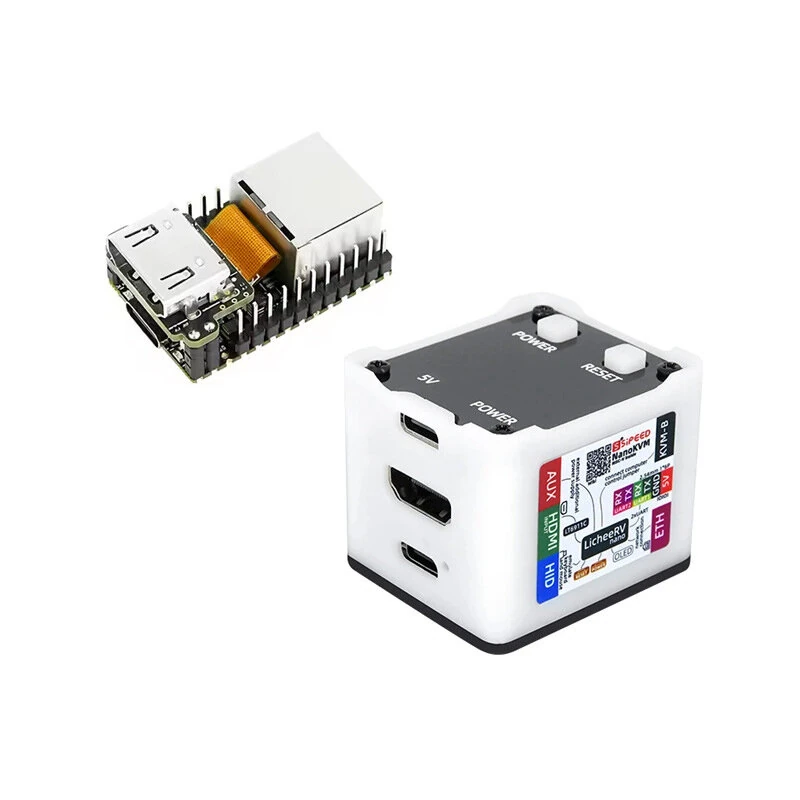

1 / 3 · Click to enlarge
The Sipeed Tang nano 1k Core board based on Gowin by Sipeed is a value-for-money iot development boards designed for everyday users. It features Item Type: Nano and Chip: GW1NZ-LV1 FPGA.
Available Offers
Free Delivery on this order. No minimum order value.
15-Day Easy Returns — hassle-free return & full refund.
Secure Payment — 100% safe checkout with UPI, Cards & Net Banking.
Available Offers
5% Cashback
Pay with UPI & get 5% cashback (up to ₹50) via Razorpay
No-Cost EMI
Available on select bank cards at checkout. 0% interest for 3 months.
Free Shipping
Free delivery on all orders. No minimum order value.
Cash on Delivery
COD available on orders up to ₹5,000 across India.
Quick Specs
Ideal For
About This Product
The Sipeed Tang nano 1k Core board based on Gowin by Sipeed is a value-for-money iot development boards designed for everyday users. It delivers reliable performance at an accessible price.
Key Specifications
- Item Type: Nano
- Chip: GW1NZ-LV1 FPGA
- Logic Units: 1152
- Buttons: 2 user programmable buttons
- LED: Onboard 1 programmable RGB
- Ambient Temperature (°C): -10 to 65
- Size (mm): 58.34 (L) x 21.29 (W)
- Shipping Weight: 0.01 kg
Why Buy from Pricio?
Pricio sources this product directly, cutting out multiple middlemen. Every order includes free shipping, a 15-day return policy, and secure payment via Razorpay.
Tang Nano 1K is a development board featuring the Gowin GW1NZ-LV1 FPGA chip. With its compact design and versatile features, it's an ideal platform for small digital logic design and experimentation. The board includes an RGB LCD interface, making it suitable for various display applications. Additionally, it comes with an onboard USB-JTAG debugger, enhancing its ease of use and facilitating efficient debugging processes.
The core of Tang Nano 1K is the Gowin GW1NZ-LV1 FPGA chip, offering 1K logic units and 1K registers. It also features 64Kb block SRAM and 128Kb user flash memory, providing sufficient storage for various applications. Equipped with two PLLs and four I/O banks, the board offers flexibility and expandability. With 44 user I/O pins, the Tang Nano 1K allows for easy interfacing with external devices, making it an excellent choice for embedded system development and educational purposes.
Features:
- Embedded FPGA logic module unit (1152 Lut4)
- Onboard USB-JTAG debugger
- Onboard FPC connector and its circuit
- Onboard wson8 pad
- 10,000 write cycles
Package Includes:
1 x Sipeed Tang nano 1k Core board
2 x 22 Pins 2.54mm header